
Twelve works, three Dharug artists and one curatorial agency are transforming a Western Sydney motorway into a living testament to Aboriginal story and place.
When the brief calls for public art along a motorway interchange, the expected outcome can be often decorative, something that softens the roadside concrete and signals some semblance of civic effort. Conversely, the M7 Motorway Public Art Collection, unveiled as part of Western Sydney’s M7-M12 Integration Project, does something far more ambitious. It reconstitutes infrastructure as an act of cultural custodianship, truth-telling and design excellence.
Commissioned by North Western Roads Group and delivered by Transurban and John Holland, the collection comprises 12 artworks curated and co-created by Balarinji , Australia’s only national public art agency devoted exclusively to Aboriginal and Torres Strait Islander work, alongside Dharug-connected artists such as Jasmine Seymour, Jamie Eastwood and Corina Wayali Norman. The result is a corridor of work that stretches from monumental bronze sculpture to illuminated structural landmarks, from ground inlay to cast aluminium, a layered landscape of story embedded into one of Sydney’s most heavily trafficked routes.
A curatorial paradigm built from within Country
Balarinji co-founder and managing director Ros Moriarty is unequivocal about what distinguishes this collection from conventional public art commissions. “Rather than the ubiquitous ‘select and commission an individual artist’ approach for Australian public places, we work from within community to develop story and art through Balarinji’s leading-edge, Designing with Country methodology,” she explains. “It’s an approach that has been culturally grounded across every interconnected step to realise the scale and impact of this corridor of works.”
That methodology, developed by Balarinji over decades, centres locally-connected Aboriginal knowledge holders, language experts and military veterans as primary creative partners, not consultants. The overarching curatorial theme, ‘To protect Country is to belong’, emerged from these conversations, orienting the collection around the Frontier Wars, the shared service of Indigenous and non-Indigenous soldiers, and the enduring Dharug relationship to Country.
“We had a client in Transurban who was committed to telling these stories, some of them revealing quite uncomfortable truths,” Moriarty says. “The result is a major collection of very significant, high-impact works with a strong presence on Country.”
Scale, visibility and the challenge of the commuter gaze
Designing for a motorway corridor presents a specific design challenge. Artworks must communicate meaning in a matter of seconds to drivers in motion and also hold depth for those who pause. Jamie Eastwood, whose works include the 50-metre tall illuminated Gili (Light) at the M7-M12 Interchange, approached this as a deliberate act of layering. “We thought about incorporating bold colours, impactful symbols and easily recognisable imagery connected to Nugura (Country) to invite curiosity,” he explains.
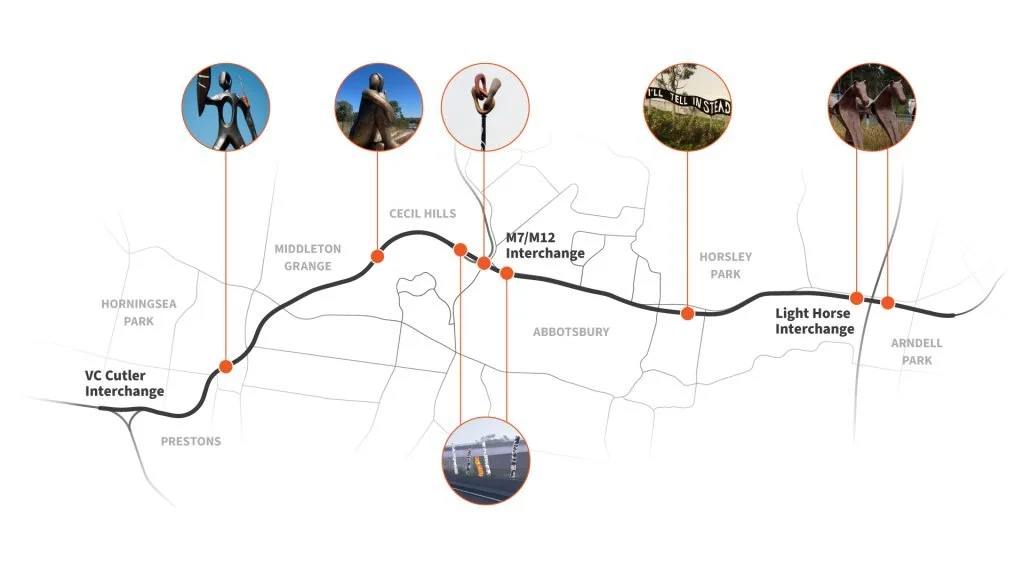
The corridor of work stretches from monumental bronze sculptures to illuminated structural landmarks, a layered landscape of story embedded into one of Sydney’s most heavily trafficked routes.
Gili, inspired by the Gymea lily and animated nightly with seasonal colours reflecting the six Dharug seasons, functions simultaneously as civic landmark and living calendar, a seasonal marker embedded in the infrastructure of a city that rarely acknowledges such systems exist.
Weaving, rhythm and the intimacy of rest stops
Corina Wayali Norman’s contribution, Dyuguma (Dilly Bag), approaches scale from the opposite direction – through intimacy rather than monumentality. Her cast bronze sculpture of a dilly bag and native currants, sited at a motorway rest stop, draws from her practice across weaving, song and dance. “Weaving has rhythm, much like song. Dance carries pattern through the body. Story lives in repetition, in shape, in what is held and passed on,” she says.
For Norman, the rest stop itself became a design consideration, a rare moment of pause in a landscape defined by movement, where the tactile logic of woven forms could subtly remind travellers they are on Dharug Ngurra, a living Country with continuing presence.
The M7 Motorway Public Art Collection ultimately argues that infrastructure and place design no longer need to be separated from deep cultural knowledge. When that knowledge is genuinely centred through methodology, the built environment becomes something else entirely: a form of country-making, carried in bronze, steel, light and story.
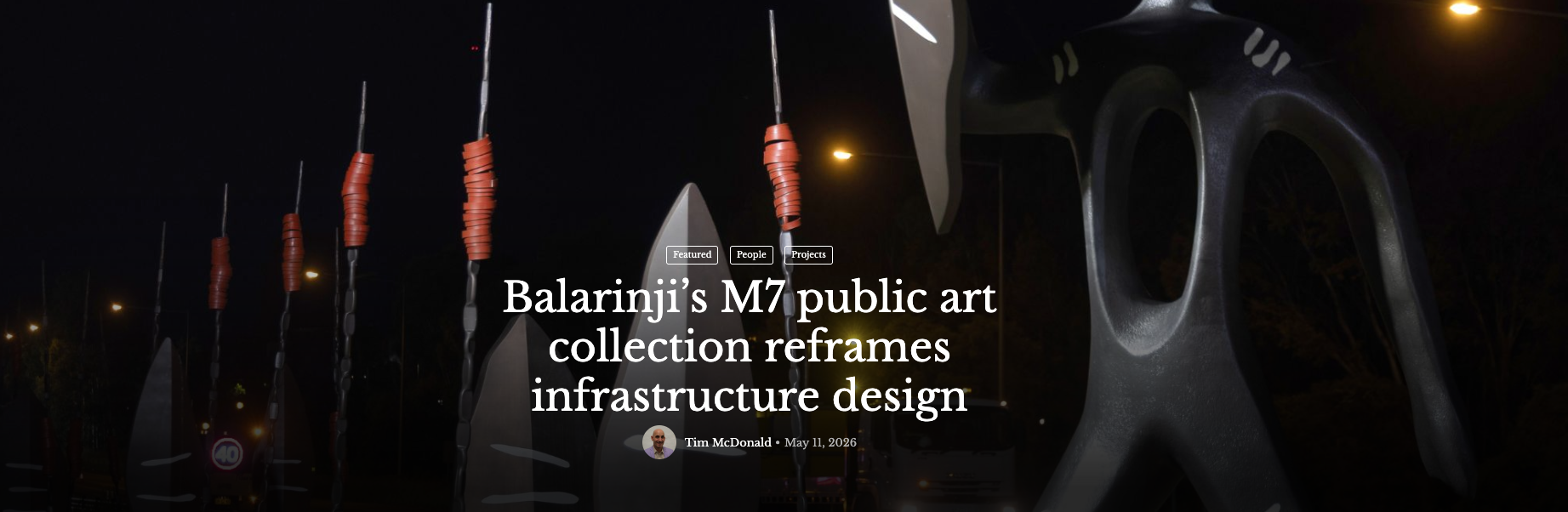
Top image: ‘To protect Country is to belong’, an installation of stylised representations of spears, shields and warriors, which honour the Dharug people’s enduring connection to the land